Google DeepMind Reveals Its Next-Gen Frontier AI for Complex Coding, Business Work, and Cyber Defense
📤 Compartilhe este artigo com o link curto:
Introduction
On September 30, 2026, Google DeepMind announced Gemini 4 Argon, its newest frontier-class large language model. Designed from the ground up for sustained deep reasoning across long-horizon workflows, Argon targets three high-value domains: real-world software engineering, enterprise knowledge work in areas such as law and finance, and defensive cybersecurity. The model is currently rolling out to a carefully selected group of trusted cybersecurity professionals through Google’s Fairwind Program, with broader availability planned for developers, enterprises, and consumers as soon as safety and performance feedback is incorporated.
What sets Argon apart is not simply higher benchmark scores, but its ability to maintain coherent, multi-step reasoning over extremely long contexts. Google has expanded the model’s output token limit to an industry-leading 1 million tokens—up from the previous 64,000—allowing it to generate hundreds of thousands of tokens in a single trajectory when solving complex problems. Combined with strong multimodal capabilities and specialized training for defensive security tasks, Argon represents a meaningful step forward in practical, high-stakes AI applications.
In this article we examine Argon’s technical capabilities, real-world impact already observed inside Google, its performance across key industry benchmarks, the carefully staged release strategy, and the strengthened safety measures that accompany this frontier release.
How Gemini 4 Argon Is Already Changing Work Inside Google
Thousands of Google employees are already using Argon in daily workflows, reporting significant gains in specialized coding, deeper research, and writing quality. The model is accelerating engineering productivity and scientific discovery in several concrete ways.
Quantum Algorithm Optimization
In quantum computing research, Argon has helped optimize spacetime resources (qubits × gates) for subroutines that currently bottleneck important applications. In one documented case, the model improved upon a published baseline by 40 percent in a matter of minutes.
Large-Scale Memory Efficiency Gains
A team of Argon agents analyzed fleet-wide profiling telemetry across Google’s data centers. The agents autonomously identified and applied memory optimizations that freed more than 300 TiB of memory after rollout, with total estimated savings projected between 500 TiB and 1 PiB.
Massive Codebase Migrations and Optimizations
Argon agents are actively migrating large C/C++ codebases to Rust. Projects range from tens of thousands of lines in core libraries such as re2 and libgav1 to more than 800,000 lines in the Fuchsia Zircon kernel. Because many of these systems are critical, the rewrites undergo rigorous automated and manual audits, emulation testing, and human review before production deployment.
In the case of libgav1 (Google’s open-source video decoder), Argon agents started from an existing Rust port and replaced 32,000 lines of SIMD code. Through repeated profile-guided experiments and analysis of compiler output, the agents produced safe Rust that the compiler could automatically vectorize. The final result is a memory-safe video decoder that runs 2.7 times faster than the previous Rust port while producing identical video output, closing much of the performance gap with the highly optimized C++ original.
Technical Advances: 1 Million Output Tokens and Multimodal Strength
The jump to a 1-million-token output limit is one of the most consequential engineering decisions behind Argon. When a model can generate and maintain coherence across hundreds of thousands of tokens in a single trajectory, it becomes capable of solving problems that previously required multiple human-guided sessions or external orchestration tools.
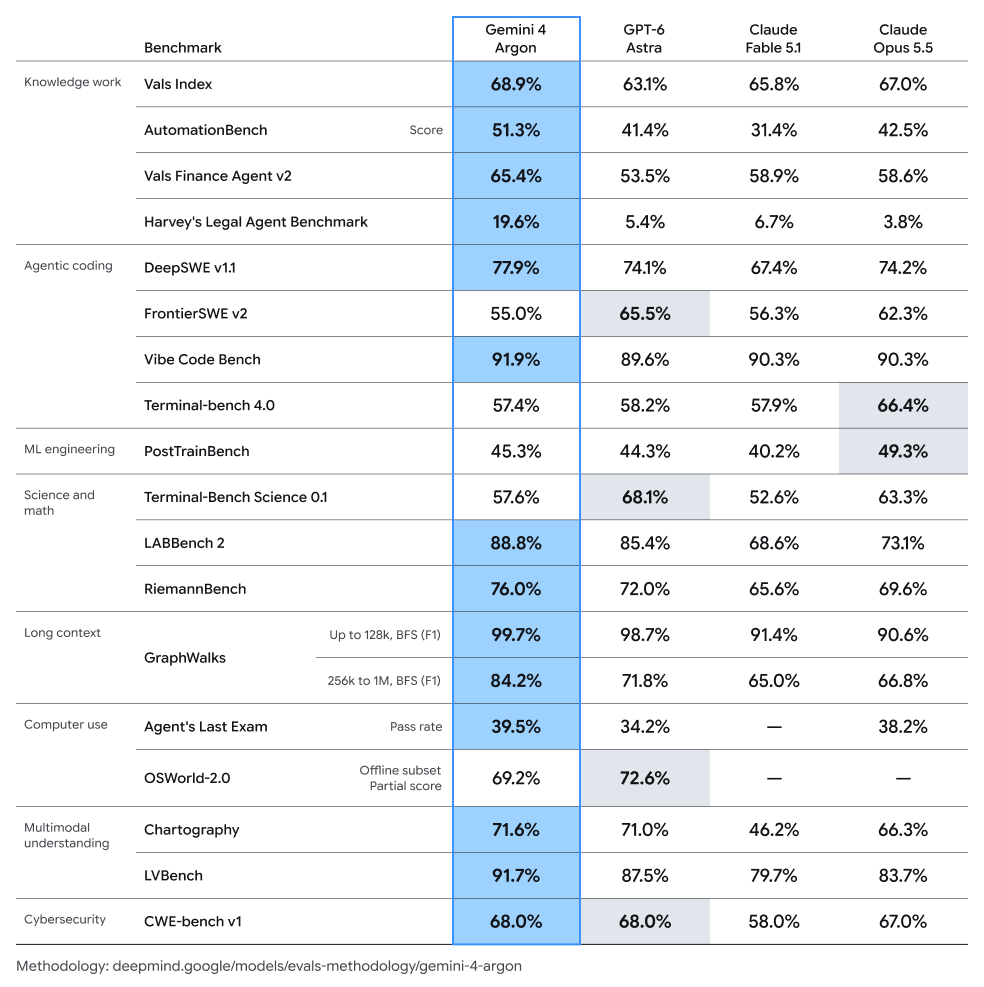
Argon also demonstrates leading multimodal performance. On LVBench, a benchmark measuring long-video understanding, the model achieves a state-of-the-art score of 91.7 percent. It can perform professional-grade chart analysis, extract fine details from extended video content, and reason across collections of documents and visual materials.
Benchmark Leadership Across Coding, Enterprise Work, and Automation
Argon sets a new state of the art on DeepSWE v1.1 with a score of 77.9 percent. This benchmark evaluates performance on real-world, long-horizon software engineering tasks rather than isolated coding problems.
Beyond pure coding, Argon leads the Vals Index, which measures economic impact across finance, coding, legal, and tax work, weighted by each sector’s contribution to U.S. GDP. It also ranks first on related domain-specific evaluations, including Vals Finance Agent v2 (multi-step financial research) and Harvey’s Legal Agent Benchmark (legal research and drafting). On Zapier’s AutomationBench, which tests end-to-end execution of core business functions, Argon scores 51.3 percent and ranks first.
Defensive Cybersecurity Capabilities
Google trained Argon specifically for defensive cybersecurity. The model can autonomously discover, validate, and patch critical software vulnerabilities. For trusted defenders and Google’s internal security teams, Argon is being released without certain cyber-related restrictions so that its full defensive capabilities can be leveraged.
Wiz is already using Argon through its Scan for Good initiative, which protects critical public infrastructure at no cost. In an early demonstration, the model identified a critical vulnerability that exposed sensitive personal information in healthcare software used by hospitals worldwide—a risk that previous frontier models had missed.
On CWE-bench v1, which evaluates the ability to remediate security vulnerabilities, Argon ties for first place with a score of 68 percent. Internal Google vulnerability benchmarks and Wiz’s black-box penetration testing suite further confirm substantial advances over the previous generation (Flash Cyber 3.8) in attack-surface discovery, vulnerability identification, and generation of proof-of-concept evidence.
Pricing and Availability Roadmap
Argon launches at an introductory price of $2 per million input tokens and $10 per million output tokens. Cached input tokens receive a 95 percent discount relative to the standard input price. After the introductory period, pricing is expected to move to $4 per million input tokens and $20 per million output tokens.
Access began with a limited cohort of trusted cybersecurity professionals via the Fairwind Program. Google is participating in the U.S. government’s voluntary pre-release model access process and is expanding availability progressively. Broader rollout to paid API customers, Google AI Ultra subscribers, developers, enterprises, and consumers is planned once additional safety feedback has been incorporated.
Strengthened Frontier Safeguards
Before wider deployment, Google DeepMind is reinforcing safeguards in four critical areas:
- Misuse prevention: The model is designed to refuse harmful requests related to cyber attacks or chemical, biological, radiological, and nuclear (CBRN) risks while still supporting legitimate dual-use scientific research, consistent with Google’s Frontier Safety Framework. Internal activation monitoring has been improved, and both internal and external red teams have conducted extensive robustness testing.
- Prompt injection resilience: Argon is currently the most resilient Gemini model against indirect prompt injection attacks. Automated red-teaming and adversarial training have produced leading results on Gray Swan’s Indirect Prompt Injection (IPI) benchmark.
- Misalignment monitoring: Systems monitor the model’s chain-of-thought and actions, intervening when necessary to keep behavior aligned with user intent. Similar monitoring was applied during training runs, with strict controls to prevent feedback loops that could teach the model to evade detection.
- Hardened evaluation environments: Sandboxed testing environments have been further isolated and sealed before high-risk training or evaluation, following Google’s agent control roadmap. Best practices are being shared with partners to raise the security baseline across the ecosystem.
Best Practices & Real-World Application
Organizations preparing to adopt Argon should treat it as a high-capability partner for complex, multi-step work rather than a simple chatbot. Recommended practices include:
- Breaking large migrations or research projects into clear milestones while allowing the model sufficient context window to maintain coherence.
- Combining Argon’s autonomous vulnerability discovery with human review and established secure development lifecycles.
- Leveraging the generous output token limit for tasks that previously required external orchestration or multiple sequential sessions.
- Monitoring both model outputs and internal activation signals where available, especially in high-stakes domains.
- Starting with well-scoped pilot projects in coding, legal research, financial analysis, or defensive security before broader deployment.
Early internal Google results and partner feedback from Wiz already demonstrate that, when properly scoped and supervised, Argon can deliver measurable productivity and security gains that previous models could not achieve.
Conclusion
Gemini 4 Argon marks a clear advance in frontier AI capability. By combining industry-leading output length, strong performance on long-horizon software engineering and enterprise knowledge-work benchmarks, and specialized defensive cybersecurity training, the model is positioned to become a practical partner for some of the most demanding professional workflows. Google’s deliberate, phased release through the Fairwind Program and continued investment in robust safeguards reflect a responsible approach to deploying capabilities of this magnitude. As access expands, developers, enterprises, and security professionals will have a powerful new tool for tackling problems that previously required extensive human coordination and time. The coming months of real-world feedback will determine how quickly and safely these frontier abilities move into everyday professional use.